- About
- Participating Artists
Uwe Tobias
Nothing, but
About the artist
Reflex Amsterdam is pleased to present Uwe Tobias, marking the international premiere of the artist’s personal body of work. While he is widely known for his collaborative practice as part of the duo Gert & Uwe Tobias, these paintings represent an individual direction, developed during the years of the COVID pandemic and brought together at Reflex for the first time.
Uwe’s oeuvre begins with a simple yet enduring question: how does an image find its subject, and how does a painting arrive at its own statement? In the vast continuum of painting, the pursuit has never been to invent in isolation, but to enter into an ongoing dialogue with history; absorbing, challenging, and extending its visual language. It is within this conversation that Uwe’s work quietly finds its place.
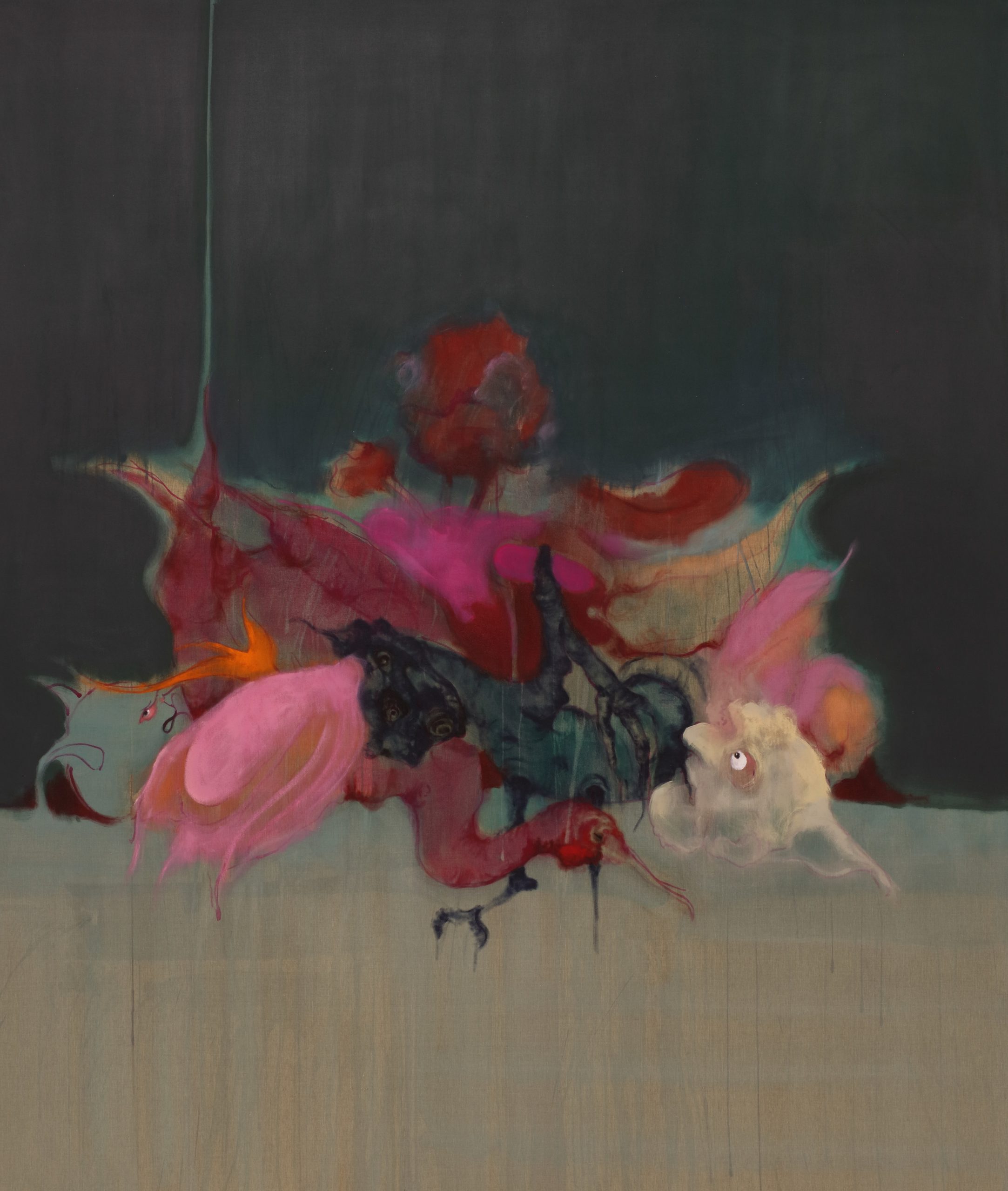
His paintings revisit enduring themes, memento mori, vanitas, still life, landscape, imagined terrains, and psychological interiors, recasting them through a personal visual language. Grotesque figures, ambiguous forms, and dreamlike spaces emerge as recurring protagonists, evoking an uncanny sense of familiarity. This recognition is deliberate: the paintings inhabit a space between memory and invention, where art-historical echoes dissolve into something both intimate and unfamiliar.
The grotesque occupies a central place within the work, becoming a site where humour and unease, beauty and distortion, intimacy and estrangement coexist. Through these tensions, the paintings meditate on impermanence, uncertainty, and the emotional complexities of the human condition. Rather than offering fixed meanings, they remain open-ended reflections on lived experience, shaped by a quiet awareness of the passage of time.
Art history functions not as a source of quotation, but as a living reservoir of images, ideas, and sensibilities. References range from Adolph Menzel’s The Dead Man at the Door and the early work of Eugen Schönebeck and Georg Baselitz to the Symbolists, Odilon Redon, James Ensor, and Edvard Munch. The intimate painterly worlds of Pierre Bonnard and Édouard Vuillard continue to shape the sensitivity to colour, atmosphere, and the emotional resonance of painting. Beyond the canvas, church architecture, ornamental decoration, and grotesque gargoyles offer enduring points of departure, where the fantastical and the sacred have long coexisted.
At the same time, the work draws inspiration from artists outside the tradition of figurative painting. Felix Gonzalez-Torres, for example, demonstrated how conceptual clarity and minimal means could carry deeply personal, emotional, and biographical narratives.
Ultimately, these references are never ends in themselves. They dissolve into a personal vocabulary shaped by intuition, memory, and the act of painting itself. The true subject is not influence but the ongoing desire to approach something that can never be fully grasped. Therefore, the mystery of the image cannot be resolved intellectually; it can only be approached, contemplated, and continually rediscovered.
Moving freely between figurative, narrative compositions and non-representational abstraction, his paintings explore recurring emotional states. Across these different forms, the same underlying questions persist: how images carry memory, how they evoke feeling, and how painting continues to offer a space where the familiar becomes strange, and the strange becomes unexpectedly intimate.